Showing posts with label evidences of big bang theory. Show all posts

Friday, 21 December 2012

The Glow From the Past


Almost all of our knowledge about the Universe relies heavily on the understanding of the Cosmic Microwave Background Radiation (CMBR). CMBR has now become an important source of information for the nature, evolution and constituents of the Universe. Its discovery was one of triumphs of the classical Big Bang theory, and the discovery of fluctuations in its isotropy was among the most convincing evidences for the Inflationary Big Bang model. Naturally, any discussion on cosmology doesn’t start without referring to the CMBR, for it’s the most ancient light that we can see.

Background about Background Radiation

To understand the origin of the CMBR we have to go back a little to the expansion of Universe. In 1924, Edwin Hubble discovered that the Universe as a whole is expanding. Based on these observations he established a law, Hubble’s law, according to which the farther a galaxy is, the faster is it receding from us. So, as one rewinds the clock, all the matter (or energy) that we see in the Universe, must have been localized at a tiny place. It is the extrapolation of the Hubble’s law back in time, which gives the age of the Universe [i.e. from the time of the Big Bang] to be 13.75 billion years.
The farther we look into the space, we peer further back in time. The light from the distant galaxies are hugely red-shifted. Computer simulations conclude that the stars with the highest redshifts, emerged when the universe was about 100 million years old (Turner, 2009). Before that time, the Universe went through a time where there was no light. There were no stars, no galaxies - just a featureless gruel of hydrogen, helium and dark matter. Fluctuations in the mass densities, caused initial clumping of matter, which became larger and larger, finally culminating into stars and galaxies that we see (This description is oversimplified. Formation of the early Universe is in itself an interesting topic). Radiation from these stars and galaxies are greatly red-shifted and are detectable only in radio frequency range.

After-glow of a Hot Past

Beyond these dark ages is the glow of the hot Big Bang. This has a redshift of about 1,100. That redshift pushes the frequency of this radiation, right into the Microwave region. What one sees, is a wall of microwave radiation which fills the sky almost uniformly. And this is the Cosmic Microwave Background Radiation (CMBR). CMBR was discovered in 1964 by Arno Penzias and Robert Wilson. Using Hubble’s Law, one concludes that this time corresponds to about 380,000 years after the Big Bang.
CMBR thus gives us a glimpse of how the Universe looked in the early epochs, and the physical processes which were predominant during that time. Any model of the early Universe should explain the features of the CMBR, and any predictions from the model should agree with CMBR observations. It thus gives us the way to model the Universe and understand its evolution.

Features of CMBR

The intensity of CMBR is same in all direction. Penzias and Wilson measured the wavelength of this radiation to be around 7.3 cm. If one assumes that the radiation spectrum is from a blackbody, this corresponds to a temperature of 3.5 ± 1.0 K. These predictions have been refined and the currently accepted temperature is 2.73 K.
There are broadly three different features of CMBR which provide direct and indirect evidence about the origin of the Universe
Angular Dependence– Intensity of radiation is almost isotropic, but has a small dependence on the direction.
Spectrum– The radiation is almost Planckian [i.e. obeys Planck’s law of radiation], but has slight deviation.
Polarization– The degree of polarization is slightly different in different directions.
In next post, we shall discuss about the origin of CMBR, and each of its features, especially the isotropy, in detail.

Citations

Turner, M. S. (2009, September). The Origin of the Universe. Scientific American.


Monday, 30 July 2012

It All Started With a Bang


Sufficient doses, of the idea that the Universe was created with a violent explosion of energy and matter, have been injected in the plebeian culture. The Big Bang theory has struck chords with millions of people, perhaps because of its close resemblance to many religious discourses on creation, but remains poorly understood.  Anyone who accepts the Big Bang theory, with no protest or skepticism, has surely failed to grasp the central point of the theory. 

We shall outline the evidences which have led the scientific consensus on the Big Bang Theory, which was counter-intuitive to most brilliant scientists.

On the ‘compulsion’ of having a beginning

The first question to be asked by a novice while big-bang-theory-indoctrination should be, “Was there a beginning?” This question, though innocent, had (and perhaps still has) vicious philosophical weight. The answer– ‘Of course! There has to be a beginning’ arises from the obvious idea of ‘causation’. Causation, as Hume said, is the cement of the universe, and lies at the heart of our conceptual structure (Kistler, 2006). To put the idea briefly, if an event e has the cause d, and d has the cause c and so on, one has to end at event a. One can argue that ‘has to end’, comes from the mere choice of finite alphabets as event-labels, instead of infinite numbers.

Our intrinsic inability, to conceptualize an infinite regress of events, makes us overlook the fact that not having a beginning is logically simpler. Avoiding a long drawn-out argument on philosophical fallacies of having a First Cause on a scientific take on creation, we instead move on to the science behind The Big Bang Theory.

The Big Bang Theory

Image credit: NASA / CXC / M. Weiss


While an entire post can be dedicated on explaining even the basics of Big Bang theory, we will suffice this post with a short introduction to Big Bang theory. The idea of a beginning first came into scientific consideration in 1927, when a Belgian, Georges Lemaitre proposed, what is called, ‘Primeval Atom Hypothesis’. According to Lemaitre’s calculations, the universe began as a tiny speck of astounding density, a “primeval atom” as he would come to call it, which swelled over the vastness of time to become the observable cosmos (Greene, 2011). When he suggested this to Einstein, Einstein remarks were, ‘Your mathematics is correct, but your physics is abominable.’

Interestingly, it wasn’t the first time that Einstein was being suggested of an expanding Universe. In 1921, Russian meteorologist Alexander Friedmann had come with a solution to Einstein’s equations (in General Theory of Relativity) which suggested that the space would stretch, causing the Universe to expand. Einstein had a deep seated belief that, the Universe had an eternal existence (which, as was pointed out before, was logically simpler) and at its largest scales– changeless. He refused to trust mathematics over his intuitions.

Einstein himself had found something unexpected with General Relativity (GR), when he had tried to apply it to the whole of the Universe. GR failed to produce a static Universe. GR, being a theory of attractive gravity, predicted that a large mass (like our universe) will either keep collapsing under its own weight or exhibit deceleration in its expansion rate if it was growing in size to begin with. In either case, a static universe  was out of the question (Gupta, 2012). With Lemaitre’s and Friedmann calculations, it seemed that the Universe, at its largest scales (i.e. intergalactic voids), is in a state of steady (though 2011 Nobel Prize in Physics was awarded to S. Perlmutter, A. Riess and B. Schimdt for discovery that the rate of expansion of the universe is increasing with time) expansion.

It would be worthy to digress from the topic a little, to mention some similarities between the Big Bang theory in cosmology and Darwinian Theory of Evolution in Biology. Just like theory of evolution is about how life evolved after the creation of DNA, the Big Bang theory explains the evolution of the universe after the moment of creation. It’s crucial to understand that the Big Bang theory is not about the bang at all. It’s the story after time t=0. To take the analogy a step further, its domain is (0,t], where ‘t’ is the present time. Just as Natural selection is the engine that drives evolution of life, General Theory of Relativity drives the evolution of the Universe.


Evidences Supporting Big Bang

Hubble’s discovery of receding Galaxies


In 1929, an American astronomer Edwin Hubble while studying the spectra of radiation from galaxies, discovered that spectroscopic lines were shifted to the red end as though there was some kind of a Doppler redshift (he formulated a relationship based on these observations, which bears his name). He correctly interpreted that, the Doppler shift (this was later to be defined as cosmological redshift, which we will discuss in subsequent posts) was due to the Galaxies moving away from us, rather than a lateral movement. If one extrapolates this backward in time, one gets the ‘primeval atom’ which Lemaitre had posited. Though there have been changes to the theory proposed by Lemaitre in subsequent decades, the discovery of receding galaxies was enough to discard the static outlook for the Universe, and establish Big Bang Theory at helm of general evolution of the Universe.

Discovery of Cosmic Microwave Background Radiation

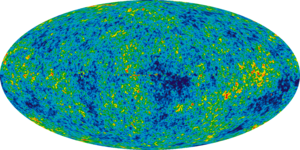
WMAP image of the cosmic microwave background radiation

Another prediction of Big Bang was the existence of a uniform radiation background in the microwave range. If the theory were correct, then space everywhere should now be filled with remnant photons from the creation event, whose vibrational frequencies are determined by how much the universe has expanded and cooled during the billions of years since they were released. Detailed calculations showed that this radiation of photons should be in the range of microwave radiation. 
A uniform microwave background was indeed discovered (accidentally) radiation in 1964 by Arno Penzias and Robert Wilson at Bell Labs. This came to be known as cosmic microwave background radiation (CMBR). The reason of its existence and its nature, are indeed interesting topics to discuss, and will be taken up in subsequent posts.


We have cited the evidences (quite superficially) that there was indeed a beginning. We haven’t touched upon many aspects of the Big Bang theory (most important of them is perhaps the Inflationary model) and subsequent course of evolution of Universe (which is what the theory is about). Food for thought– what was there before Big Bang? We will start the next post with an answer to this question and a more detailed outlook on the Big Bang theory.

Citations

Greene, B. (2011). The Hidden Reality. New York: Alfred A. Knopf.
Gupta, P. D. (2012, March). General Relativity and the Accelerated expansion of the Universe. Resonance, pp. 258-259.
Kistler, M. (2006). Causation and Laws of Nature. New York: Routledge, Taylor & Francis Group.